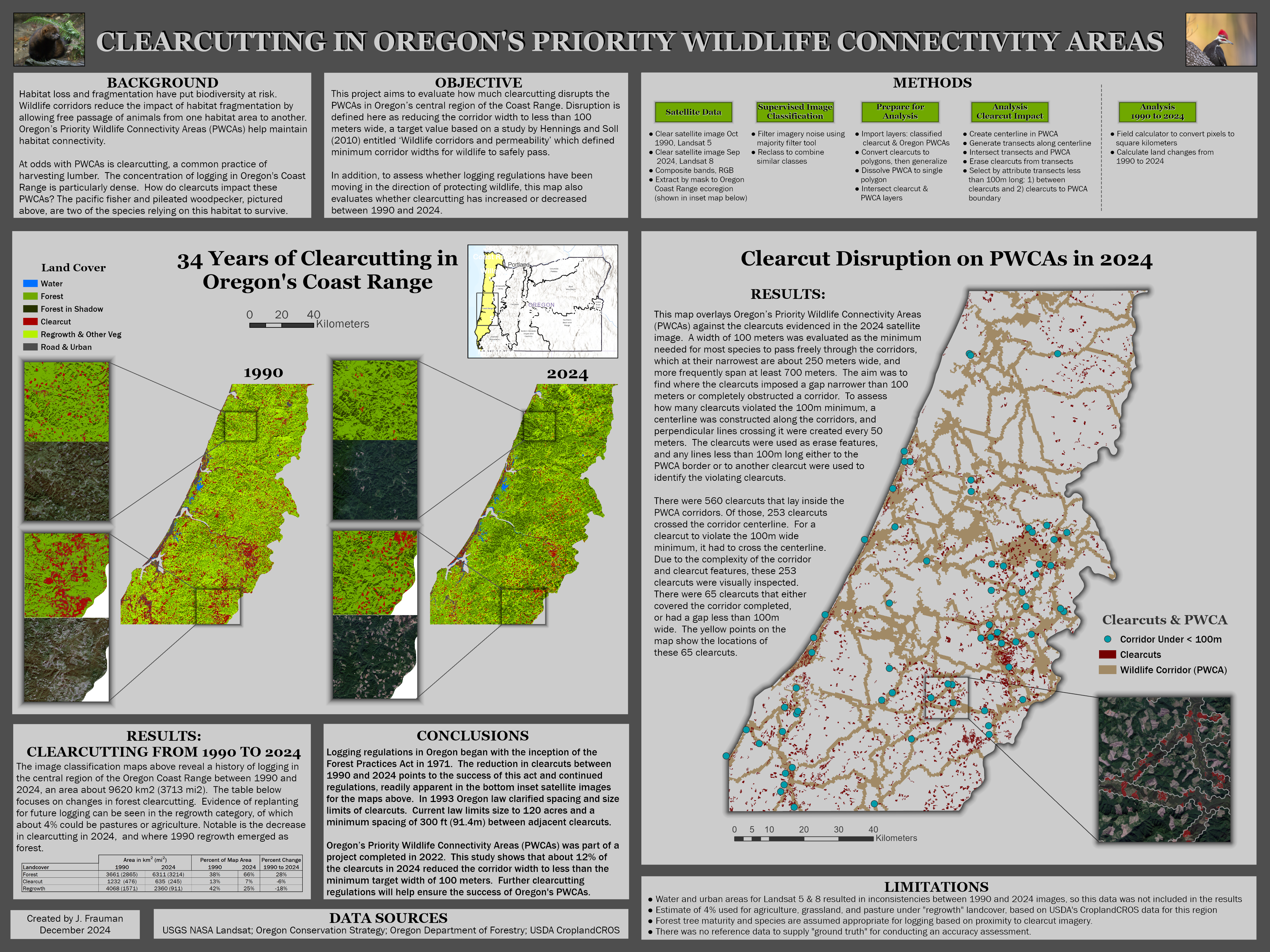
Habitat loss and fragmentation have put many species at risk. Habitat connectivity is critical for species to move freely as they search for food and places to breed. The State of Oregon, with the aim to improve or maintain the well-being of wildlife, published a wildlife corridor action plan in January 2024, which includes Priority Wildlife Connectivity Areas (PWCAs).
At odds with wildlife corridors is the lumber industry, an important part of Oregon's economy. Clearcutting has been the traditional forestry method for harvesting trees. This map examines the impact of clearcutting on Oregon’s PWCA. It also evaluates, through historic satellite imagery, whether recent forestry regulations have reduced clearcutting.
This GIS analysis focused on the southern region of Oregon's Coast Range. Satellite images were downloaded from Landsat 5 for 1990 and Landsat 8 for 2024. ArcGIS Pro was used for the analyses and layout. Two analyses were performed. One used supervised image classification to evaluate the change, if any, on clearcutting over those 34 years. The second analysis used the 2024 satellite data and Oregon's Priority Wildlife Connectivity Areas datasets to assess the degree clearcutting disrupts the wildlife corridors.
Source credits provided within map.